
The Town of Wayland


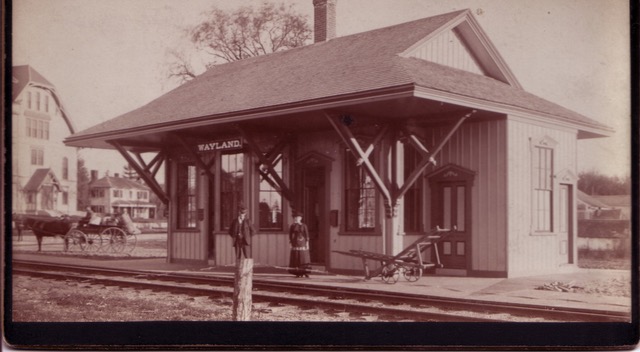
Wayland Depot

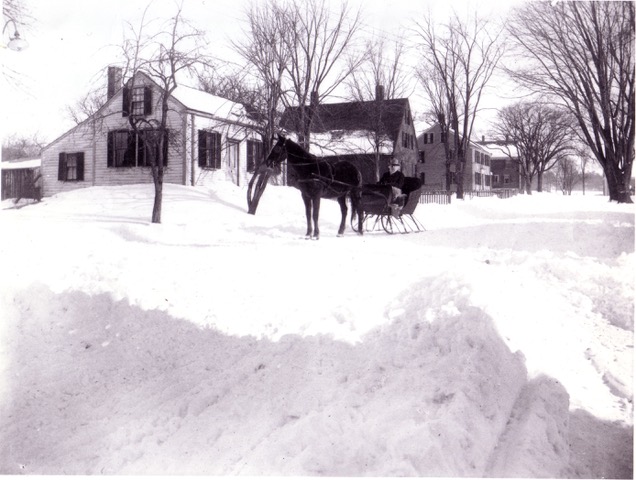
Pelham Island Road
Join us for walking tours on the last Sunday of the month!
The Wayland Museum & Historical Society is a 501(c)(3) nonprofit organization. Free to visit. Supported by members and donors like you.
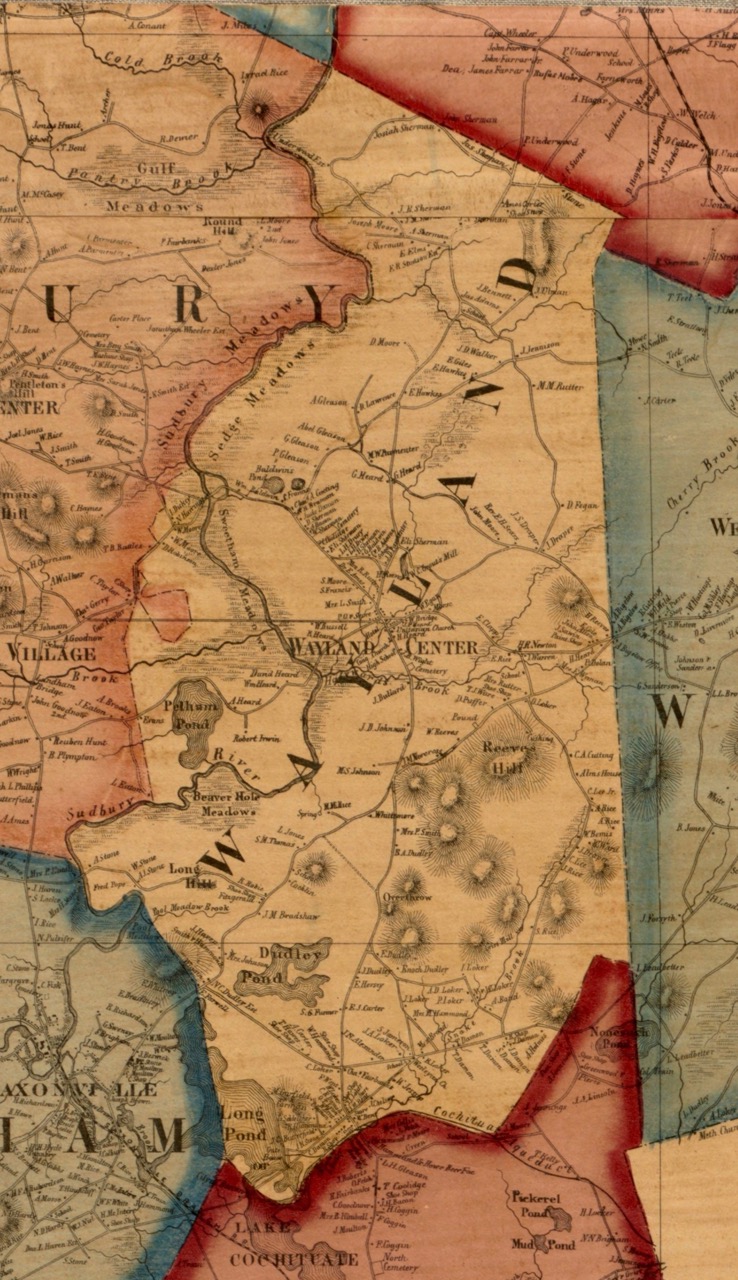
Wayland sits on land that was home to the Nipmuc and Massachusetts peoples long before European settlement. For thousands of years, the waterways, forests, and meadows along what the Nipmuc called the Musketahquid — meaning “grassy banks” — sustained Indigenous communities whose presence shaped the landscape we see today. That land had been actively managed for generations: cleared, cultivated, and traveled along paths that the first European settlers adopted as their own roads. Two devastating epidemics in 1616 and 1633 had severely reduced local tribal populations before the Puritans arrived — a fact that made the land seem available, but did not make it unoccupied or unclaimed.
Thousands of years before European settlement, land near Dudley Pond served as a sacred burial site for native peoples. When construction work in the late 1950s disturbed a knoll near West Plain Street and Old Connecticut Path, professional archaeologists determined the site was a 3,000- to 4,000-year-old cemetery, with an intensive concentration of burial pits and a stone-lined crematory. Hundreds of stone axes, adzes, gouges, pestles, and a soapstone bowl were unearthed — and much of the irreplaceable archaeological data was lost before professionals could document it. The Wayland Historical Commission is working with the Peabody Museum and Native tribes to repatriate remains and funerary objects from this site in accordance with the Native American Graves Protection and Repatriation Act (NAGPRA). We honor that full history as part of Wayland’s story.
Wayland was established as a European settlement in 1638 and incorporated in 1639. Among the 60 original men, women, and children were 15 Puritan families who had traveled from England on the ship Confidence. Those founding families — the Curtises, Grouts, Stones, Haynes, Noyes, Bents, and Goodenows — brought with them English patterns of farming, collective fields, and grazing along individual lots, naming their town Sudbury after the parish in Suffolk where their first minister, Edmund Brown, had served. The original settlement clustered around what is now North Cemetery and the Old Cow Common — not today’s Wayland Center, which came later.
Within ten years, the town had established the first Town Meeting, a system of government still used in towns throughout New England today. From the beginning, Wayland’s citizens pushed back against overreach. In 1654, one of the earliest establishments of the separation of church and state in the colonies came from a meeting here, when town Selectman John Rudduck confronted a gathering of ministers seeking pastoral authority over town affairs and declared: “We shall, or should, be judged by men of our own choosing.”
The full story of this period includes a history that has long gone unacknowledged. Sudbury’s colonial inhabitants — the town that would become Wayland — kept enslaved persons, bought and sold them, paid taxes on their human property, and bequeathed them in wills. The owners included some of the most prominent men in town. Samuel Parris — the Puritan minister whose accusations against Tituba, an enslaved woman in his household, helped ignite the Salem witch trials of 1692 — spent his final years here, dying in Sudbury in 1720 after serving as the town’s schoolmaster. He brought enslaved people with him from a Barbados sugar plantation; his presence connects Wayland’s colonial past directly to both the institution of slavery and one of the most infamous episodes in American history.
In North Cemetery, near the Noyes family graves, two people known as Peter Booz and Flora — described in historical records as former slaves of that family — are buried at right angles to all the surrounding graves, a distinction that marks them as set apart even in death. Their stones are among the most direct physical evidence of enslaved life in this community, and they can still be visited today.
Existing histories have made little or no mention of African Americans, many of whom were enslaved here — a gap that recent scholarship is beginning to address, including Jane Sciacca’s Enslavement in the Puritan Village (2025), which focuses directly on colonial Sudbury and Wayland. Sciacca has deep roots in this research: she served on the editorial committee for the Wayland Historical Society’s own Wayland Historical Tours (2013) and has been a board member of this institution.
This museum holds primary source material that speaks to that history directly: the antislavery writings of Lydia Maria Child, who lived at 91 Old Sudbury Road and devoted decades of her life to the cause of abolition; the account book of the Boston Vigilance Committee, which helped enslaved people reach freedom; and objects that reflect both the activism and the painful cultural legacy of this era. We are committed to telling that story as part of Wayland’s complete history.
A century before the Revolution, Wayland was the site of one of King Philip’s War’s most dramatic confrontations. On April 21, 1676, more than 1,000 fighters under Metacom — known to the English as King Philip — attacked the town. The Haynes Garrison on Water Row held for nearly eight hours against overwhelming odds, its defenders issuing out to fight rather than wait within the walls. Captain Samuel Wadsworth and his relief force of approximately 50 men were ambushed and killed at Green Hill, vastly outnumbered. Fifty-six soldiers from this period are buried in North Cemetery, where their graves can still be visited today.
The war’s aftermath was equally devastating for the Indigenous people who had lived alongside the settlers for decades. Nipmuc families who had chosen to live peacefully alongside the settlers — including Jethro, a longtime friend of the town who had lived at Nobscot Hill — were rounded up regardless and sent to Deer Island in Boston Harbor, where many froze or starved. Jethro was later executed after being betrayed. There is no record of any Sudbury men coming to his defense. The meadows and paths that both peoples had shared for generations were forever changed.
By April 19, 1775, Wayland sent more men to Concord than any other town — over 300. That march is recreated every year on April 19th by the Sudbury Minutemen, and 56 soldiers from that era are buried in North Cemetery. Colonel Henry Knox’s cannon train from Fort Ticonderoga passed through Wayland in the winter of 1776, crossing Stonebridge Road and Old Connecticut Path on the way to Dorchester Heights — the cannon that forced the British evacuation of Boston. George Washington passed through Wayland en route to take command in Cambridge in July 1775. Paul Revere stopped here in 1774 on a patriot mission to Philadelphia.
By 1780, the eastern parish had separated from Sudbury under the name East Sudbury. In 1835, the men attending town meeting voted to rename it Wayland, to honor Rev. Francis Wayland, President of Brown University — a close friend of local Judge Edward Mellen, whose law office still stands on the village green. And in a milestone that still defines the town’s civic character, the Wayland Library — founded in 1848 in what is now Collins’ Market on Cochituate Road — was the first free public library in Massachusetts and the second in the country.
Wayland’s women shaped the town and the nation in equal measure. Lydia Maria Child — abolitionist, suffragist, and author — lived at 91 Old Sudbury Road and became one of nineteenth-century America’s most powerful antislavery voices, editing the National Anti-Slavery Standard and writing works that reached millions. Her brother James Francis also lived in Wayland. Edmund Sears, whose church still stands on Boston Post Road, wrote “It Came Upon a Midnight Clear” while serving as Wayland’s Unitarian minister. Hazel Wightman dominated American tennis for decades and founded the Wightman Cup. Mary Sears, a pioneering oceanographer and Wayland resident, led a Naval intelligence unit during World War II whose tidal calculations saved thousands of lives at Iwo Jima and the Battle of the Philippine Sea — earning her the distinction of having a 300-foot Navy research vessel named in her honor, the first ever named for a woman. Gladys Widdiss, a member of the Wampanoag Tribe of Gay Head, raised her family in Wayland while leading her tribe as president from 1978 to 1987, securing federal recognition and reclaiming the Gay Head Cliffs and cranberry bogs for the Wampanoag people. Her life bridges Wayland’s Indigenous past and its modern community in a single story.
Evangeline Marrs grew up on family farmland along Dudley Pond in Cochituate, and in 1882 became the wife of textile magnate Michael Simpson, who built her an enormous Victorian mansion on West Plain Street known locally as “the Castle.” After Simpson’s death in 1884, Evangeline’s life took remarkable turns. She began a passionate decades-long partnership with Rose Cleveland — sister of President Grover Cleveland, who had served as acting First Lady — a relationship documented in intimate letters and now recognized as a landmark of nineteenth-century LGBTQ history. She went on to become an important champion and generous supporter of social justice for women, Native Americans, and war refugees, both in the United States and abroad, continuing that work in Minnesota and later in Italy, where she and Rose Cleveland lived together until Rose’s death from influenza in 1918. The only known photograph of the two women together was taken here in Wayland. The mansion itself burned to the ground in 1956. Three years later, construction on the site disturbed a 3,000-year-old Indigenous burial ground — the sacred place described above. Its story — and Evangeline’s remarkable life — is part of the Wayland that this museum preserves.
Henry David Thoreau walked Wayland’s fields and fished its rivers regularly. The landscape that inspired Walden extended well beyond Concord — Wayland was part of that world.
In the second half of the nineteenth century, Cochituate Village emerged as a thriving industrial center built around the shoe manufacturing trade. What began in the 1830s as William Bent cutting shoe parts in his house grew within a generation into a four-story factory employing over 300 workers by 1870. The Bent family’s enterprise transformed the southern end of town — known first as Bentville — as additional factories opened under the Dean, Griffin, and Williams families. Immigrant workers arrived in waves: French-Canadian, Irish, German, Albanian, and Greek families settled along Main Street and Commonwealth Road, building their own churches, schools, and social halls. The Cochituate Methodist Church opened in 1866; St. Zepherin’s Catholic Church, founded by French-Canadian and Irish parishioners, followed in 1889. Electric trolleys soon connected Cochituate to Natick, Saxonville, and eventually Wayland Center, and by the early twentieth century factory workers could commute to other towns when the shoe industry declined. The neighborhood they built — the streets, the cemeteries, the gathering places — remains a distinct and living part of Wayland today.
In the twentieth century, Wayland produced and attracted people who left marks far beyond its borders. Robert Hawkins — the first Black golf club manager in New England, at Wayland’s Sandy Burr Country Club, and the first African American in the country to build, own, and operate his own golf club — used sport to create spaces of dignity and belonging for Black Americans at a time when they were excluded from most of American civic life. Ted Williams — widely considered the greatest hitter in baseball history — called Wayland home. Vaughn Monroe, whose rich baritone voice defined an era of American popular music, launched his career with an early engagement at Seiler’s Ten Acres in Wayland. Tom Scholz, founder of the rock band Boston and one of rock’s most celebrated engineers, recorded the band’s landmark debut album in a basement studio in the Wayland area. Archibald Cox, the Watergate special prosecutor whose dismissal during the Saturday Night Massacre shocked the nation, lived in town. Amar Bose — engineer, inventor, and founder of Bose Corporation — built his company while living in Wayland. Robert Anastas pioneered seatbelt safety research that has saved millions of lives. Mary Sears led a Naval oceanographic intelligence unit from here whose wave and tidal calculations shaped the Pacific campaign of World War II. And Gladys Widdiss, a Wampanoag woman who raised her family in Wayland, spent her life fighting for the rights and recognition of her people — and won.
Today Wayland is a semi-rural community in the MetroWest region, just 18 miles from Boston, with the meadows and marshes along the Sudbury River kept relatively unspoiled. Those meadows — the same “grassy banks” that gave the Musketahquid its name, the same grasslands that drew the first Puritan settlers in 1638, the same waters where Thoreau fished and Metacom’s fighters defended their land — are still here. The Sudbury Valley Trustees, founded by Wayland and Sudbury residents in 1953 specifically to protect them, have ensured that this landscape endures. In a town shaped by nearly four centuries of history, the land itself is the longest story of all.
That history — all of it — is what this museum preserves.
Read the full history of Wayland’s founding and growth. Explore the East Sudbury period: 1780–1835. Learn about Wayland today. The Mansion Inn: stories behind a Wayland landmark.
The Wayland Museum & Historical Society is a 501(c)(3) nonprofit organization. Free to visit. Supported by members and donors like you. Join us.